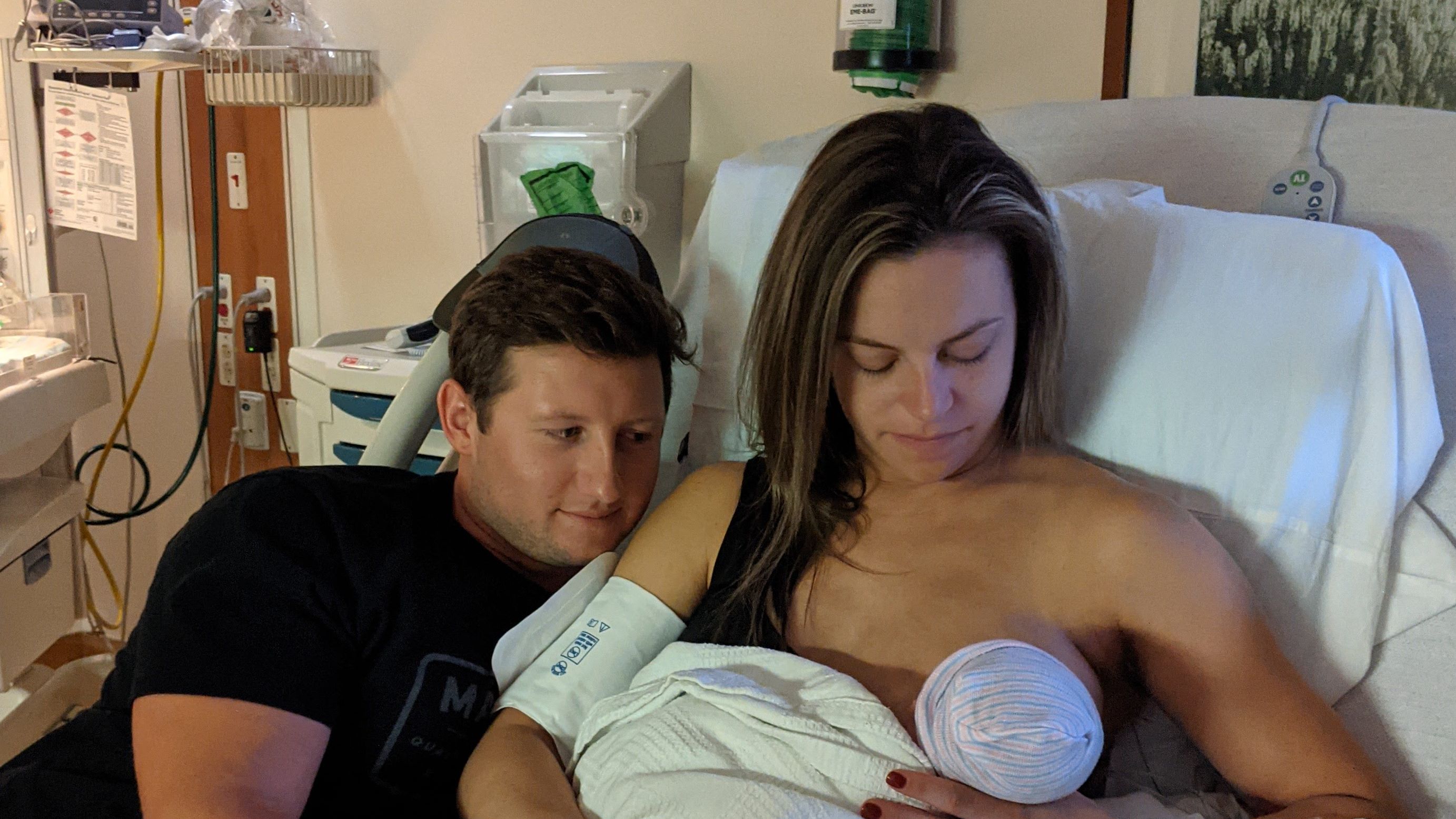
A Good Latch Isn't Luck. It's Good Practice.
Jun 17, 2026
Nobody warns you that the hardest part of breastfeeding might be the first 30 seconds of it.
You finally have your baby. You're flooded with hormones and exhaustion. And now this tiny human, who has never eaten a meal in their life, is supposed to latch onto your body correctly... while you, who have also never done this, guide them.
No pressure or anything.
Here's what I tell every family I work with: a good latch is a skill, not a personality trait. You're not "bad at breastfeeding" because it didn't click on day one. You and your baby are both brand new at this. You're learning each other.
So let's actually learn it together.
What a Good Latch Looks Like
A good latch is DEEP. Your baby shouldn't be chomping on your nipple (this isn't a game of hungry, hungry, hippo). They should have a big mouthful of breast, nipple AND a good amount of areola, with the nipple landing far back toward the soft palate.
Signs you've got it:
- Their mouth is open WIDE, like a yawn, with lips flanged out like a little fish
- Their chin is pressed into your breast, nose free or barely touching
- You can hear or see swallowing, not just clicking or smacking
- It feels like tugging, not pinching, biting, or burning
If it feels like your nipple is hurting or being cut, that's not a "tough it out" situation. That's a shallow latch, and shallow latches are how nipples get destroyed and supply takes a hit. SO LET'S NOT DO THAT OKAY FRIENDS. IT DOESN'T HAVE TO HURT!
How to Get a Good Latch
1. Get comfortable FIRST. Pillows behind your back, baby supported, shoulders down away from your ears. If you're hunched over straining your neck, you'll be sore and baby will be unstable. Bring baby to breast, not breast to baby. And while were at it, unclench your jaw and wiggle it out because why not.
2. Line up nipple to NOSE. Not nipple to mouth, nipple to nose. This feels wrong, I know. But when your nipple tickles their nose and upper lip, baby tilts their head back and opens wide, and the nipple lands deep in their mouth where it belongs.
3. Wait for the WIDE open. This is the part everyone rushes. Baby opens a little, we panic, we shove (no hungry, hungry, hippo remember?) Wait for the big yawn-sized open (you can encourage it by brushing your nipple against their nose and their chin so close it actually starts to touch the beast), then as soon as you see that giant yawn, bring them straight on to you, nice and close.
4. Chin first, head tilted back. Their chin should hit the breast before anything else. This lets their lower jaw scoop up a big mouthful of breast tissue. Their head stays slightly tilted back, like how you drink a glass of water.
5. Check the bottom and top lip. You probably can't see it (it's buried in breast, that's good), but if you gently pull down near their chin, that bottom and top lip should be flipped outward, not tucked in.
If It Hurts, Start Over
I mean it. Don't white-knuckle through a bad latch hoping it improves mid-feed. It won't, and your nipples will pay for it... this is the time to build good latching and feeding skills (for both of you).
Slide a (clean!) finger into the corner of baby's mouth to break the suction, take a breath, and try again. Relatching ten times is better than one painful feed and gets baby more practice on big, deep latches.
Pain, cracking, bleeding, lipstick-shaped nipples after feeds (you will know exactly what I mean if this is you), or dreading the next feed? NOT normal, and not something you have to accept as the cost of breastfeeding. That's your sign to get eyes on your latch from someone trained to help. (I got you.)
The Truth Nobody Says Out Loud
Breastfeeding is natural, but it is not automatic. Those are two very different things.
You wouldn't expect to run a marathon without training just because running is "natural." Same deal here. The families who struggle least aren't the lucky ones, they're the prepared ones.
If you want to walk into those first feeds actually knowing what you're doing (latch, positioning, how milk supply works, what's normal vs. what needs help), that's exactly what I teach in my Lactation 101 Mini Workshop. Learn it before baby arrives, so you already have an idea of where to start once baby is here.
You've got this. And when it's hard, that doesn't mean you're failing. It means you're learning.
Happy you're here,
Kyndrick
SUBSCRIBE FOR WEEKLY Pregnancy, Birth, Postpartum Tips, Tricks, and Info!
We hate SPAM. We will never sell your information, for any reason.